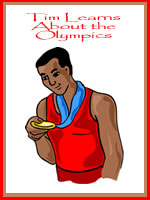
Esta publicação é especialmente destinada ao público infantil interessado no aprendizado da língua inglesa, bem como ao público adulto que deseja aproveitar desse conteúdo.
Esta obra é acompanhada de seu texto integral. Este material pode ser apreciado gratuitamente e não se destina ao uso comercial.
A short history of the Olympics especially for Tim The Tadpole.
As you may know, there’s a young tadpole who lives in the palace pond with prince Bertie the frog, and his name is Tim. Tim goes to the school for tadpoles, and at the end of every term the school always holds swimming races. Just recently, Tim was very excited because he came second in the backstroke race and he won a silver star. The only problem was that the star wouldn’t stick to him because he was too wet. But all the same, he was very pleased and when he saw Bertie he said
Yippeee ! I won a prize. I’m a champion swimmer !”
“Well done little Tim,” said Bertie, “ When you grow up to be a big green frog like me, you’ll win a medal in the Olympics !”
“Will I? Will I? “ asked Tim. “That’s Grrrreat ! I going to win a medal in the Olympics Er, Bertie, What’s the Olympics?”
“Ah yes,” said Bertie, who likes showing off his knowledge,” It’s when all the fastest, strongest, and most agile athletes from all over the world meet up and see whose best at each sport. It happens every year in a different country and everyone watches it on television.”
“Rubbish !” said Colin the Carp who had been overhearing this conversation. “Don’t go believing anything that comes from Bertie , In actual fact, The Olympics only happen once every four years.”
“Ah yes, didn’t I say that?” asked Bertie?
“No, you didn’t,” said Colin, “Because you’re ignorant.’
“Will I be ignorant too when I grow up?” asked Tim, who didn’t know what it meant. But nobody was listening. Tim didn’t like not being noticed, so he grew more excited and his voice grew more squeaky: “Bertie Bertie do tell me more about the Olympics because you used to be a prince and princes know everything… Why do they only happen every four years. That’s an awfully long time to wait…?
And Bertie said: “Well little Tim. As a matter of fact, Princes don’t know quite everything, but they can find out anything. And I’ll find out the whole history of the Olympics for you. In fact, I’ll ask Natasha about it right away.”
And so Bertie asked me to tell Tim the entire history of the Olympics. As I didn’t actually know it all, I went to the Palace Library to look it up. And so here is the History of the Olympics, especially for Tim.
The Olympics began over two and half thousand years ago in Ancient Greece. In those days Greece was made up of several different states including Athens, Sparta and Corinth, and they were often at war with each other.
But when the games were on, they held a truce, The greatest event was held at a place called Olympia, and that’s why the games were called the Olympics. They were held once every four years in honour of Zeus, Lord of all the Gods. But the Olympics weren’t the only important games – there were three other great festivals of sport too – which is why the Olympics only came round once in every four years.
The longest race and toughest race of all, the Marathon, also takes its name from ancient Greece. In 490 BC, the Greek states came together to fight off a vast and powerful army of invaders from the Person Empire. The battle took place at Marathon, and a soldier called Pheidippides, ran all the way back to the city of Athens. After he had given the people the news that they were saved, he died of exhaustion.
Eventually the ancient Olympics were abolished by the Roman Emperor, Theodosus the First, who was a Christian and didn’t like the games because of they were dedicated to a pagan god. But the Olympics were always remembered as a symbol of human achievement and peace.
Almost 1,500 years later, a French aristocrat called Pierre de Coubertin campaigned to restart the games in the cause of peace between nations.
The first modern Olympics were held in 1894 in Athens , the capital of Greece. The Greek hosts were delighted when the Marathon race was won by a Greek Shepherd, , Spyridon Louis.
The next games were hold in 1900 in Paris, which was at that time hosting a World Fair showing off all the most advanced inventions that people thought would change the world in the Twentieth Century. But the organisers decided to spread the games over five months, and so they lacked any focus and hardly got noticed.
The Oluympic Games continued to be held every four years, and they grew and grew in popularity. , In 1936, the Olympics were held in Berlin, the capital of Germany. The African American Jesse Owens won four gold medals for sprinting and long-jumping.
The games were held again in Germany, this time in Munich in 1972. In those days, the Olympics were almost seen as a kind of competition between the Soviet Union – which was the Communist empire of Russia – and te western world, especially the United States. Many of the Athletes of the Soviet Union, although brilliant at their sports, did not often smile very much in public. But one, a tiny young gymnast called Olga Korbut won the hearts of everyone on both sides of the divide with her charm and skill. She was the first person ever to do a backward somersault on the balance beam during a competition. On the American side, the mustachioed swimmer, Mark Spitz , won seven gold medals, and still holds the record for the most gold medals won in a single Olympic games.
In 1980 the games were held in Moscow, the capital of the Soviet Union. America refused to let its a athletes go to the games as a protest against the recent Soviet invasion of Afghanistan. But even without the Americans, the sport was memorable, especially the middle distance races in which the two English runners, Steve Ovett and Sebastian Coe competed against each other for gold and glory. The two athletes really didn’t like each other – and their private differences added plenty of interest to the competition on the track.
In recent times, a big problem has been the suspicion that some athletes take drugs to make them stronger and faster. In 1988, in Seoul, Ben Johnson was stripped of his gold medal after he failed a test for drugs. At the Athens Olympics in 2004, 24 athletes were discovered to have taken drugs.
Now that China is growing in wealth and power, there is a hint of a return to the old East West Rivalry. But as in the times of Ancient Greece, most people see that it’s much better to compete in the sports arena than to fight outside it.
The modern games still keep the ideal of peace, harmony and good sportsmanship, even if they don’t always quite live up to it. History shows that it’s a real struggle for peace and sport to triumph over war and politics, but it’s a goal worth striving for.
And that’s the story of the Olympics – not quite the entire history – but I hope that both you and Tim found it interesting.